The essentials
- Lichens are almost the only living things able to colonise Timanfaya's lava directly, according to a University of La Laguna study.[1]
- The sea of lava covers about 70% of the park, and its vegetation is reduced to a lichen community covering large areas of it.[2]
- The latest catalogue of the park's vascular flora lists 298 taxa, in a park with no natural tree cover.[1]
- In La Geria, vines grow in individual pits because the picón layer can reach 3 metres, and they can stand up to 4 m apart.[3]
- DO Lanzarote vines average 30 to 50 years old, are spur-pruned and are harvested without any kind of mechanisation.[3]
| Lichens | Lapilli farming | Malvasía vines | |
|---|---|---|---|
| What | Near-only colonisers of bare lava[1] | A traditional dry-farming method[4] | Grapes for Bodega La Geria's Malvasia wine[5] |
| Where | The sea of lava, about 70% of the park[2] | La Geria, where picón can be 3 m thick[3] | La Geria, the island's main vineyard area[6] |
| How | Moisture from nighttime dew[1] | Lapilli keeps soil moisture, stops erosion[4] | Planted in pits, harvested by hand[3] |
| A figure | Cones habitat, 20% of the park[2] | Vines up to 4 m apart in La Geria[3] | DO Lanzarote vines: 30 to 50 years old[3] |
authentic 'champions of survival in the harshest conditions', capable of surviving even the conditions of outer space
What to look for between the lava and the vines
In the park
Lichens, the first life on the lava
A paper in the journal Vieraea by University of La Laguna botanists says lichens play a fundamental role in Timanfaya, because they are almost the only beings able to colonise directly the lava that covers most of the park.[1] It notes that they have been called true champions of survival in the most hostile conditions, able even to survive the conditions of outer space.[1]
The park's most representative lichen communities, for their extent and effect on the landscape, are two associations of fruticose lichens, Ramalinetum bourgeanae and Stereocauletum vesuviani.[1] The second, dominated by Stereocaulon vesuvianum, is one of the most typical pioneer communities on recent lava: moderately nitrophilous, light-loving, drought-resistant and practically a single species.[1]
Nighttime dew is an important source of moisture, and the same paper says it notably favours the development of life in an inhospitable, seemingly lifeless environment.[1] It classes the park's climate as arid and subdesert, though much softened by the trade winds and the nearness of the sea.[1]
The park's habitats, from lava sea to kipuka
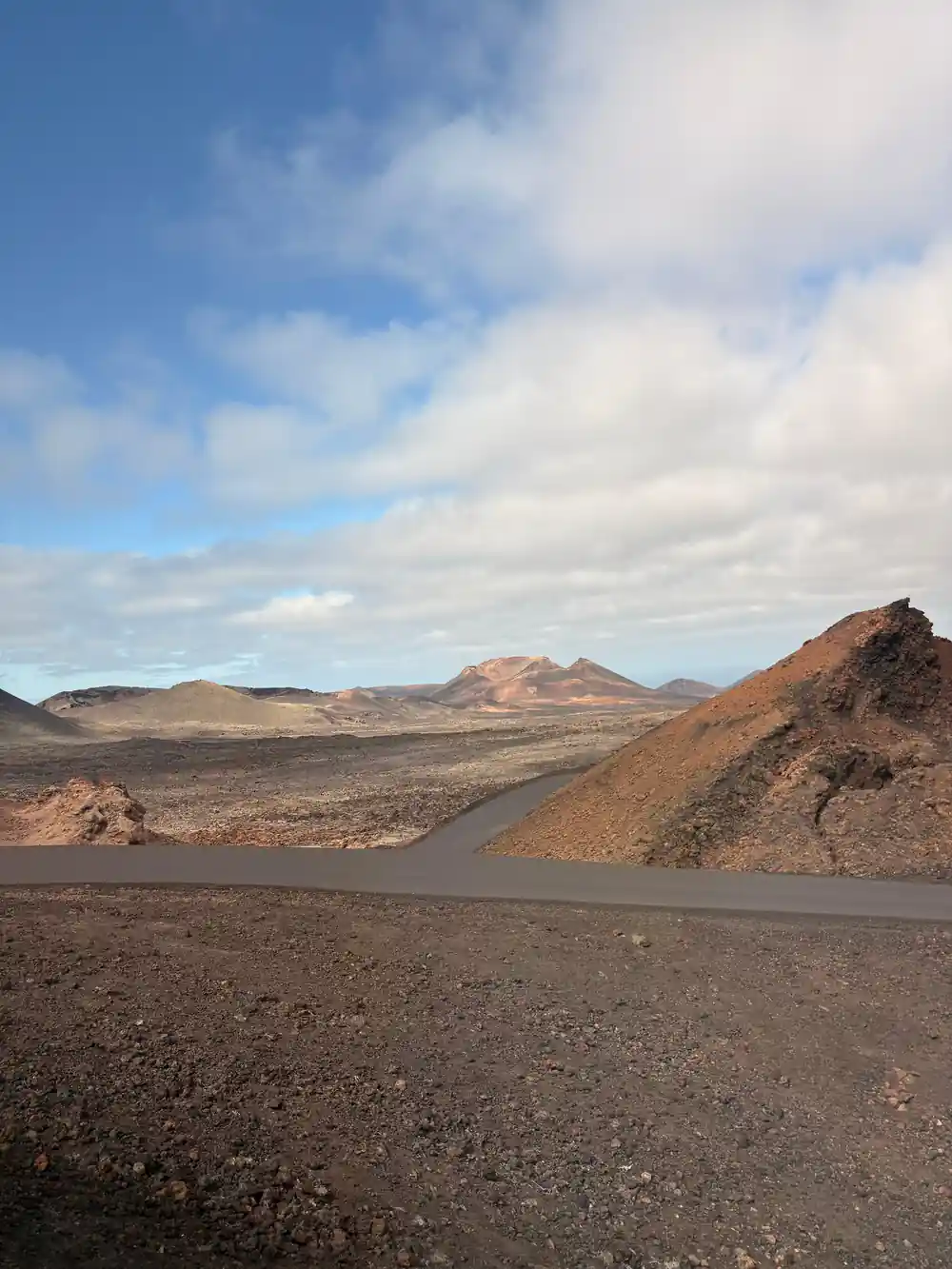
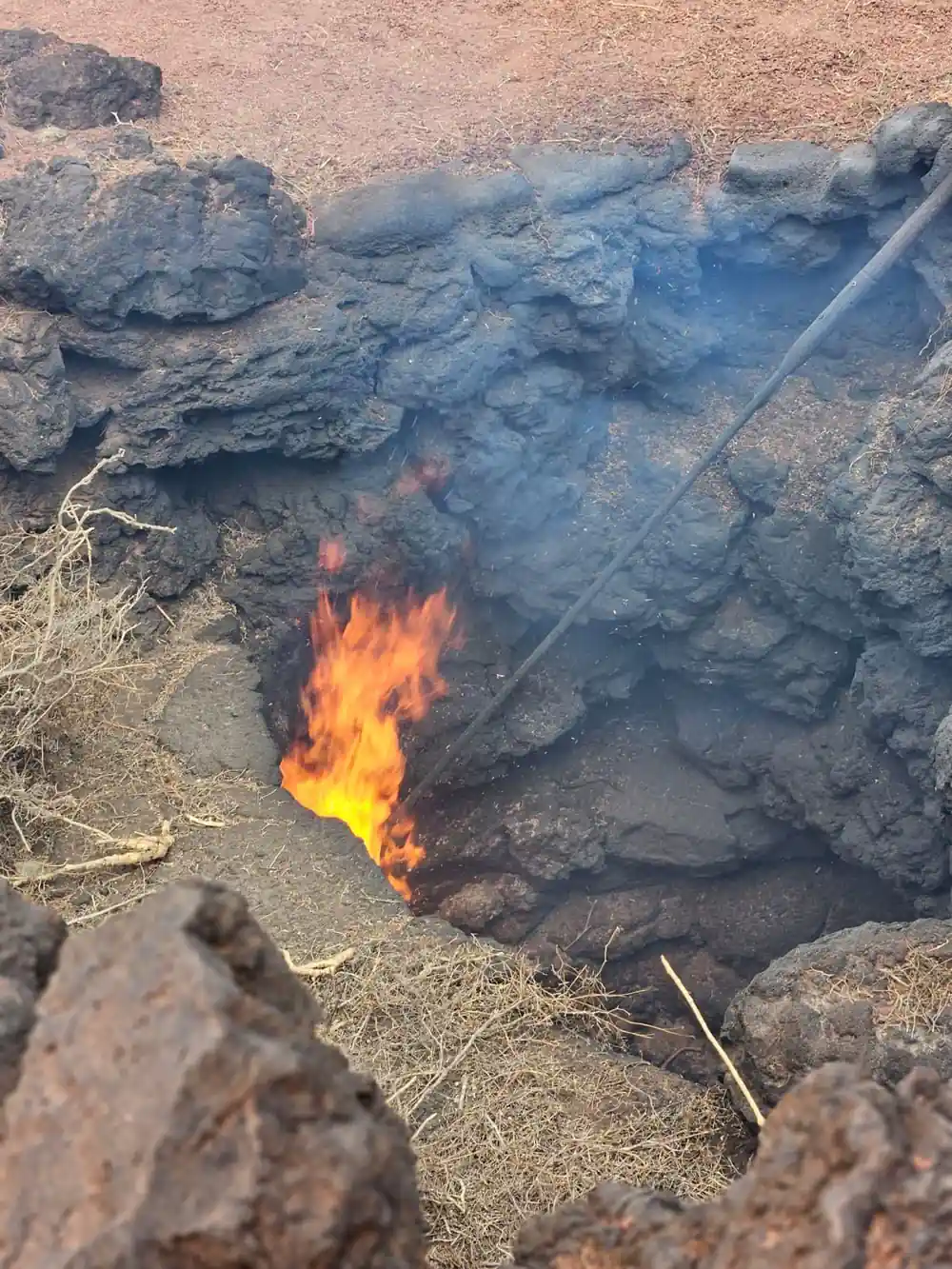
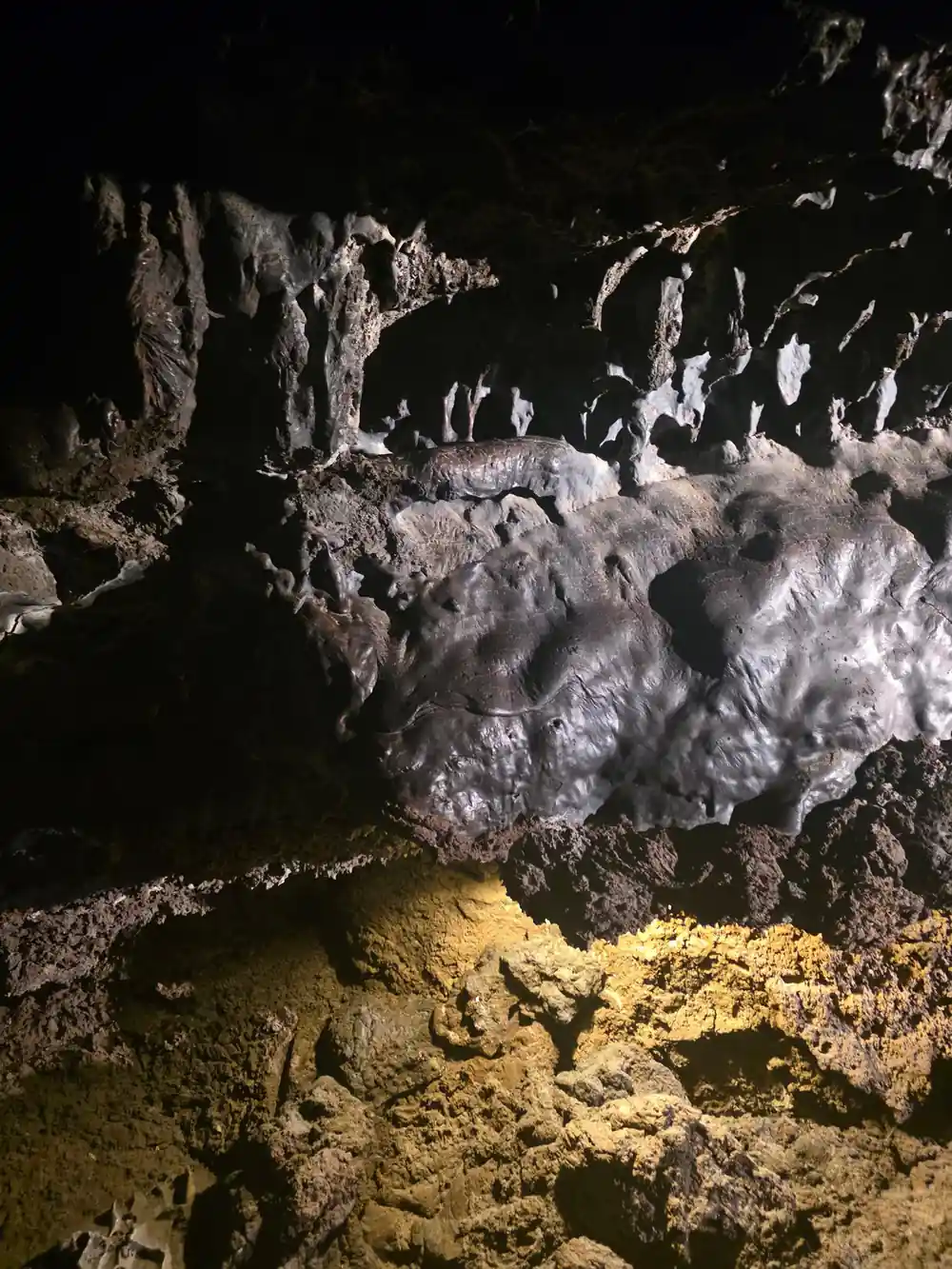
MITECO divides the park's ground into habitats. The sea of lava, roughly 70% of the park, is a vast, irregular surface of different lava types full of caves, tubes and cavities, and its vegetation is reduced to the lichen community covering large areas of it.[2]
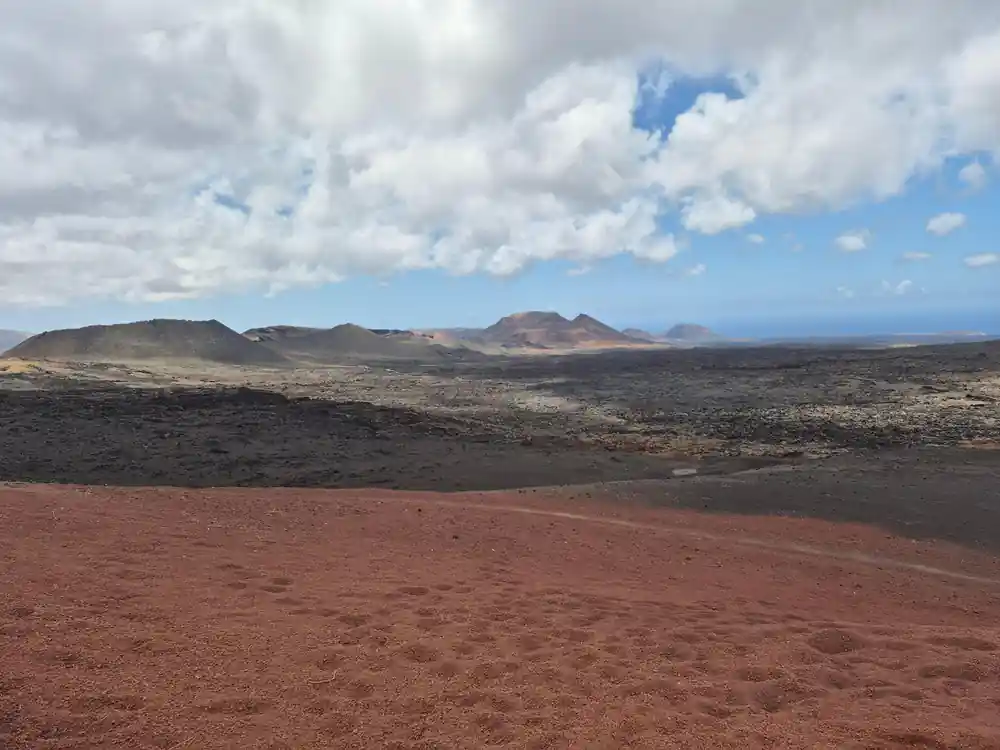
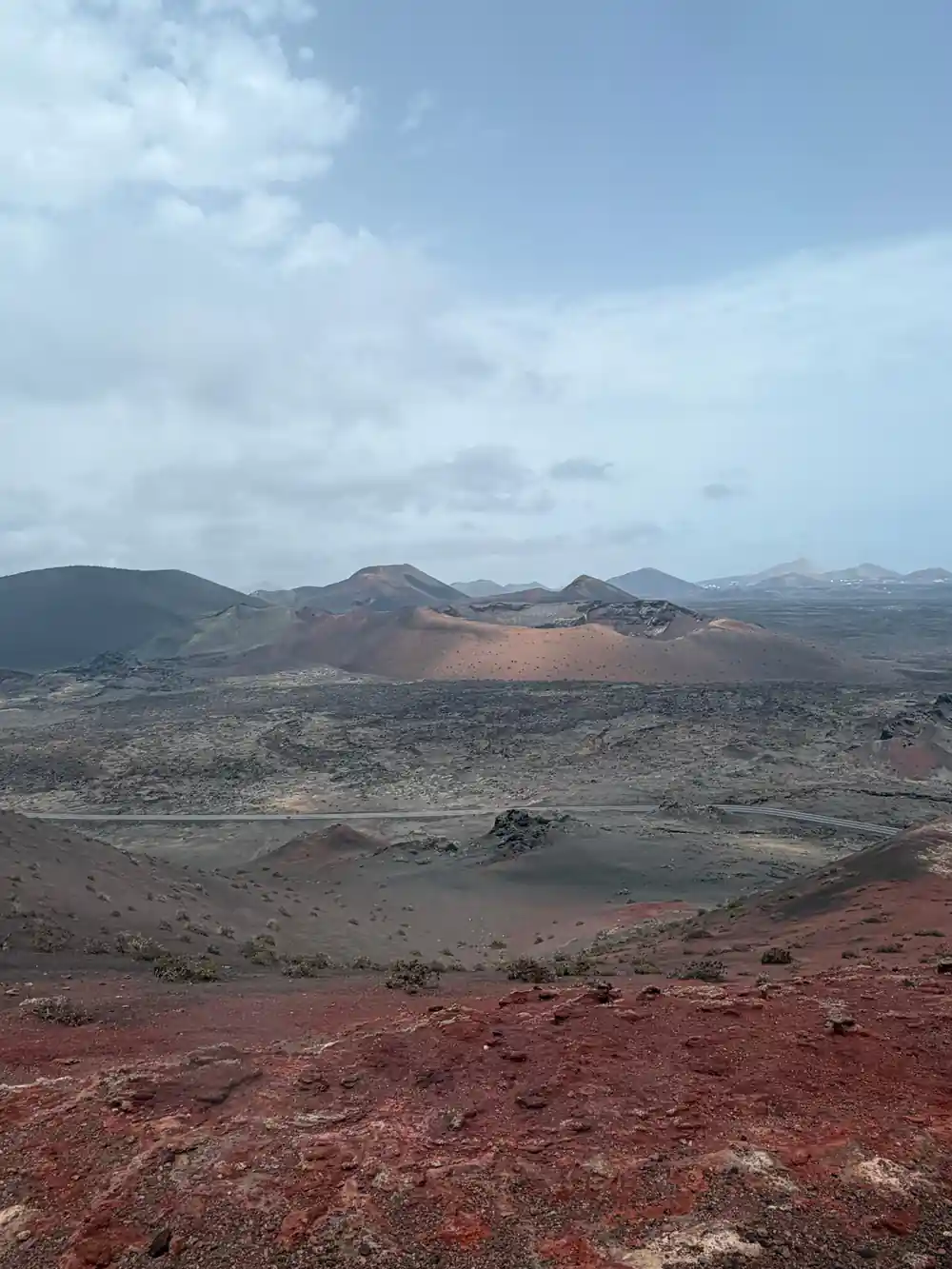
Cones and hornitos cover 20% of the surface. Their steep walls carry only lichens, and because they are so hard to reach they are one of the preferred nesting places for the park's birds.[2]
Older surfaces that the recent lava did not cover are usually called islotes in Lanzarote, and are known internationally as kipuka.[2] On those older surfaces grows the tabaibal, and MITECO singles out the tabaibal of El Mojón, with a vegetation cover of 75-80%.[2]
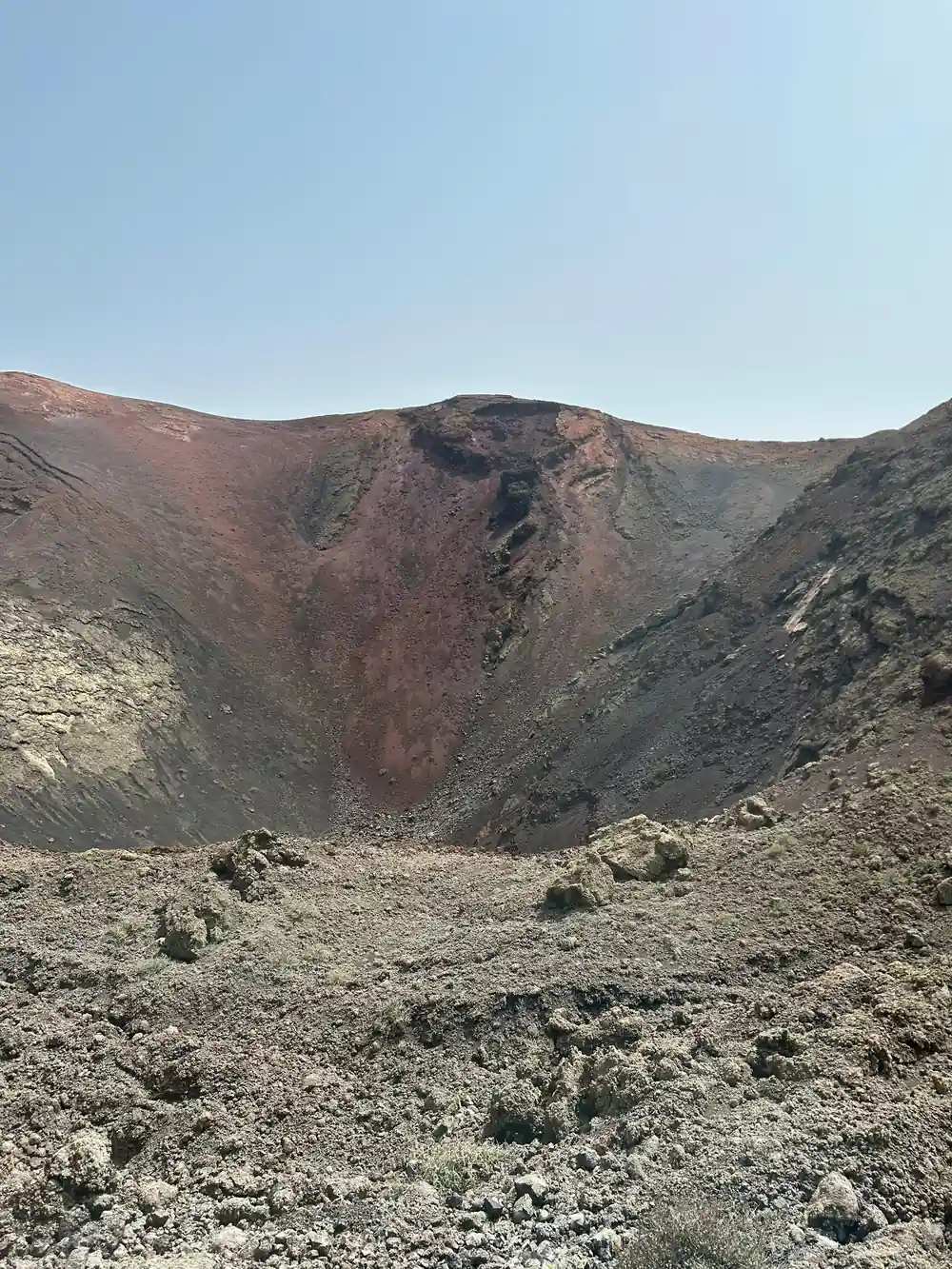
Black ash fields stretch between volcanic cones
The plants and birds that survive
The most up-to-date catalogue of the park's vascular flora lists 298 taxa, though their presence is very uneven and in some cases only testimonial.[1] The Vieraea paper says the lack of natural tree stands and the park's low altitude limit lichens that grow on plants: besides fig trees, only a small group of plants carries them, among them Euphorbia balsamifera, Euphorbia regis-jubae, Rumex lunaria, Launaea arborescens and Lycium intricatum.[1]
MITECO's species index for the park names plants such as the frosted fig-marigold, the Canary sand-spurrey, the espino cambrón shrub and the estornudera de Lanzarote, alongside the pioneer lichen Stereocaulon vesuvianum.[12] Its fauna list includes birds such as the trumpeter finch, the canary, the roller, the reed warbler and the common kestrel.[13]
Life gathers along the coast beyond the park as well. The Charco de Los Clicos lagoon at El Golfo, connected to the sea through underground cracks, is green because of the large number of plant organisms suspended in it.[14] The Janubio lagoon, formed when the 1730-36 eruptions cut it off from the sea, is a refuge for many wading birds, among them many migratory species.[14]
Protected ground, inside the park and beyond
Collecting plants, animals or rocks of any kind or size, or any part of them, is forbidden inside the park.[7] The park's visit rules ask everyone to travel only on the authorised roads and paths, and Turismo Lanzarote's advice is that walking over the lava or other volcanic material is not possible.[8][10]
The protection reaches beyond the park. Some 41.6% of Lanzarote's surface falls under a category of the Canary Islands network of protected natural spaces, and UNESCO declared the whole island, with all its towns, a Biosphere Reserve on 7 October 1993.[15] MITECO also lists the park's ZEPA designation as a Special Protection Area for Birds, granted in 1994.[16] Lanzarote was also named a UNESCO World Geopark in 2015.[17]
298
The number of taxa in the most up-to-date catalogue of the park's vascular flora, many of them unevenly present.[1]
Farming in the ash: figs, zocos and camels
Farming survives even inside the park. MITECO describes fig trees grown on private plots within its boundary, behind volcanic-stone walls like zocos that shelter them from the strong prevailing winds, over about 5% of the park around Montaña Tremesana, María Hernández, Pedro Perico and the Miraderos zone.[18]
UNESCO says lapilli farming is one of the Geopark's key traditional dry-cultivation methods, letting farmers retain soil moisture and prevent erosion while making efficient use of the island's porous volcanic soils.[4] The ash stones used measure between 2 and 20 mm and are called lapilli, known in the Canary Islands as picón and in Lanzarote as rofe.[19]
A Cabildo de Lanzarote guide says the shape of camels' feet lets them walk over rofe without sinking, which made them indispensable for building La Geria's pits and the walls of its socos.[20] Camels also carried pruning waste and took the grapes at harvest in special harvest boxes.[20]
How La Geria grows vines in volcanic ash
La Geria covers a wide area in the centre of Lanzarote, partly occupied by recent lava from the 1730-36 eruption, with volcanic cones of different heights rising above it.[14] The DO Lanzarote council explains that the hole system is used there because the lapilli or picón layer can be up to 3 metres thick in some areas, which makes planting density lower than on the rest of the island.[3]
Vines in La Geria can stand up to 4 m apart, against 1.5 to 2 m in the north and about 1.5 m in the Tinajo area.[3] Across the appellation, vines average 30 to 50 years old, are spur-pruned, and are harvested traditionally without any mechanisation.[3]
The council's current rules cap production at 7,000 kg of grapes per hectare, while the original 1993 regulation set its cap at 50 quintales, or 5,000 kg, per hectare.[3][21] The Lanzarote Film Commission places the Volcán del Cuervo, the first of the Timanfaya eruptions, in the heart of the Protected Landscape of La Geria, where the film Eternals (2020) was shot.[17]
Lanzarote wine, La Geria wineries and the tour
The Denominación de Origen Lanzarote was recognised by an order dated 14 December 1993, and a new regulation approved by an order of 7 February 2011 repealed the original.[21][22] The original regulation set the production zone in seven municipalities: Arrecife, Haría, San Bartolomé, Teguise, Tías, Tinajo and Yaiza.[21] The appellation's logo, a black volcano seen from above with sheets of red lava and a golden circle, is an image created by César Manrique.[22]
El Grifo, a Lanzarote winery, says it has been making wine since 1775.[23] Its 120-minute Wine Lovers tour, limited to 12 people, pairs a walk through the vineyard with a 6-wine tasting and Canarian cheeses, from €50 per person.[11] Its tasting of 5 selected wines costs from €30 and does not include a winery tour, and its self-guided audio tour with 2 wines costs from €15.[11] Bodega La Geria opens from 10:00 to 19:00, with tastings and tours on the production of the famous Malvasia wine.[5]
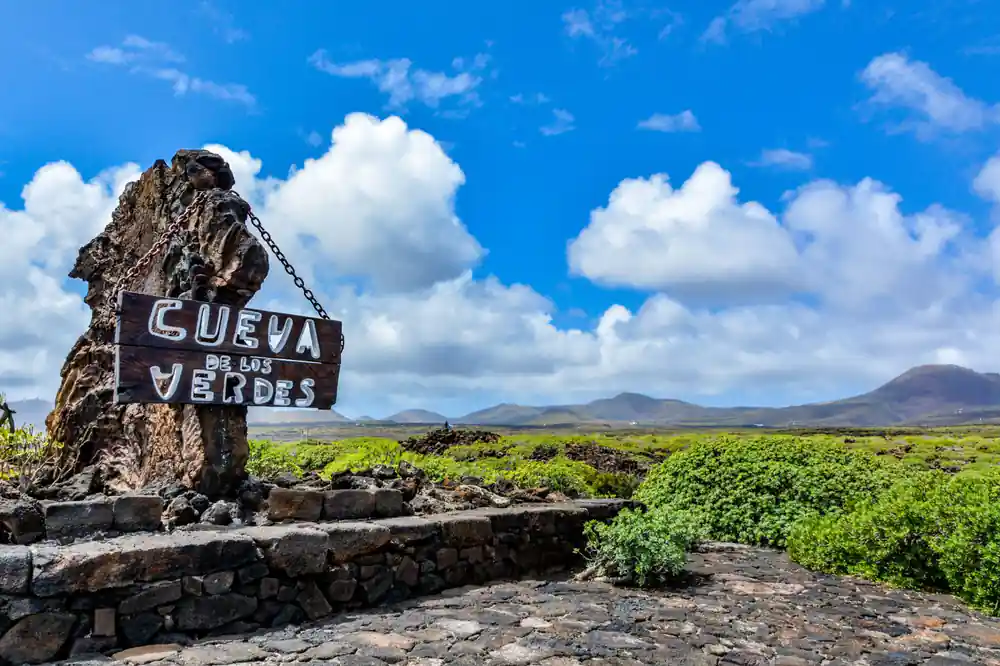
The tour booked from this site lists Timanfaya National Park, Cueva de los Verdes and Jameos del Agua as its stops, and La Geria is not among them.[24] A separate 5.5-hour Timanfaya National Park and La Geria tour is listed from US$73, and a 4-hour La Geria vineyards hiking tour from US$54.[25][26]
How Timanfaya's surface divides by habitat
Shares of the park's area in MITECO's habitat descriptions: the lava sea, the cones and hornitos, and the fig plots.[2][18]
Price a Timanfaya or La Geria tour
Each amount is that listing's own "from" price in US dollars, and the calculator applies the same listed figure to every traveller.[24][25][26]
Dates and figures behind Lanzarote wine
From bare lava to wine
Lichens reach the lava
Lichens are almost the only organisms able to colonise the park's lava directly.[1]
Dew brings moisture
Nighttime dew is an important source of moisture that favours life in the park.[1]
Ash covers the fields
The small ash stones of 2 to 20 mm are called rofe in Lanzarote.[19]
Farmers dig pits
In La Geria the picón can be up to 3 metres thick, so vines are planted in holes.[3]
Camels build the walls
Camels could cross rofe without sinking, which made them indispensable for building pits and walls.[20]
Grapes are picked by hand
The DO Lanzarote harvest is carried out without any type of mechanisation.[3]
See Timanfaya's lava fields on the day tour
from US$103Reserve now & pay later