The essentials
- UNESCO describes the La Corona lava tube as a 7.6 km structure with various access points known as jameos.[1]
- Its last 1.6 kilometres are submerged, which UNESCO says makes it the longest submerged volcanic tube on the planet.[1]
- Local people used the galleries of Cueva de los Verdes as a refuge from North African pirate raids in the 16th and 17th centuries.[2]
- The Jameos del Agua lake forms from seawater filtering through the tube, follows the tides and holds the endemic Munidopsis polymorpha.[3]
- The tour booked from this site lists Cueva de los Verdes and Jameos del Agua as its stops after Timanfaya National Park.[4]
| Cueva de los Verdes | Jameos del Agua | Atlantis Tunnel | |
|---|---|---|---|
| What it is | Tube galleries, once a pirate refuge[2] | Tube openings with a tidal seawater lake[1][3] | The tube's submerged final stretch[1] |
| Length | Part of a conduit of more than seven kilometres[2] | On the 7.6 km La Corona tube[1] | The last 1.6 km[1] |
| Visiting | Guided, about 50 minutes[2] | Open 10:00-18:00, every day[3] | Below today's sea level[5] |
| Ticket or status | From €17; children 0-6 free[2] | From €17; children 0-6 free[3] | Evidence of last-glaciation sea levels[5] |
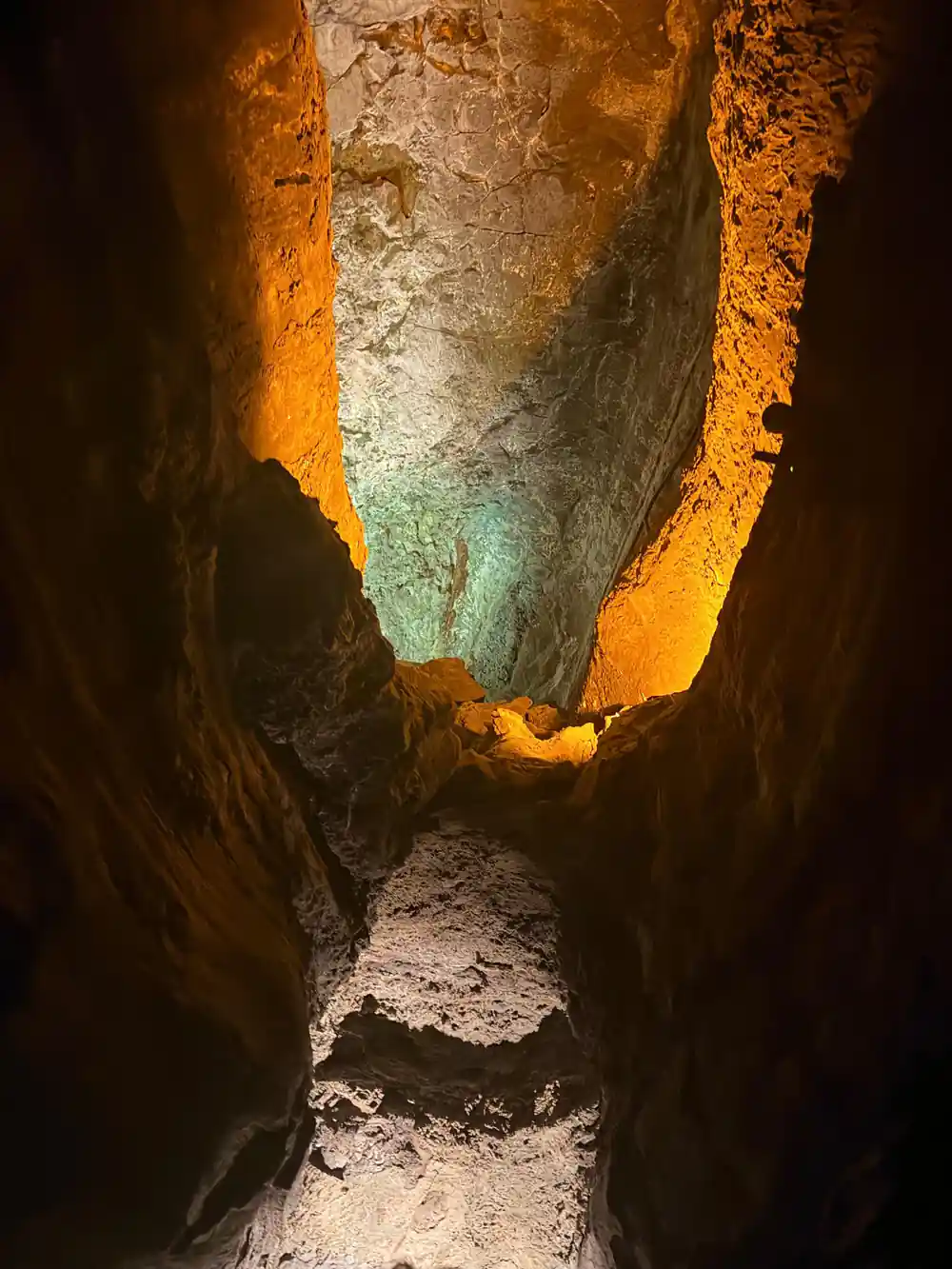
During the 16th and 17th centuries, local people used these galleries as a refuge from pirate raids from North Africa.
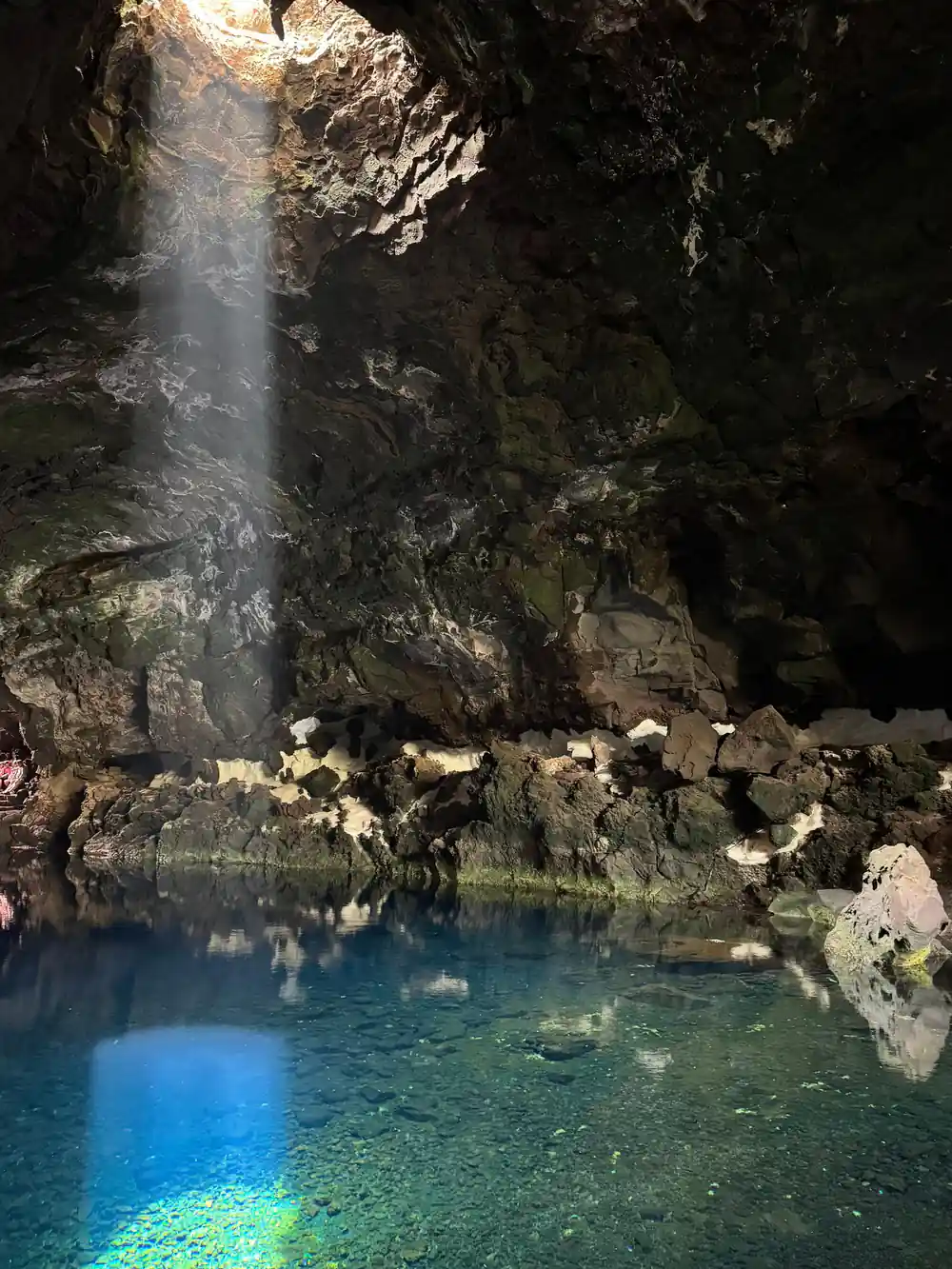
The lake forms as seawater filters through fissures in the volcanic tube. Its level follows the tides and can reach the access walkway during spring tides.
Two caves on one lava tube
Cueva de los Verdes
How a river of lava became a tunnel
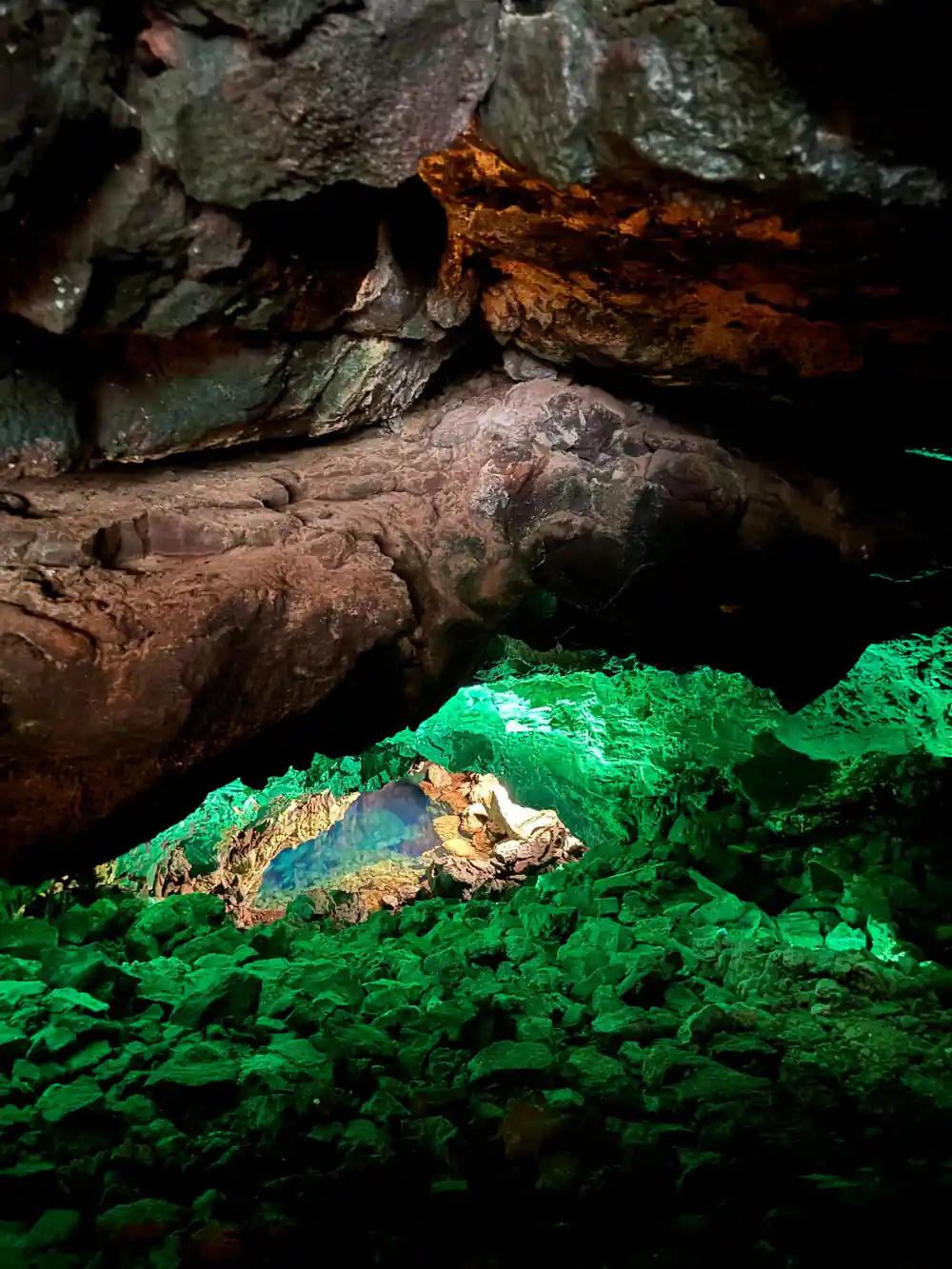
The Corona lava tube formed during the eruption of the La Corona volcano about 25,000 years ago, according to IGME.[5] MITECO's explanation of volcanic tunnels describes the process: rivers of fluid lava harden on the surface but keep flowing inside, becoming underground rivers of lava.[8]
Once the lava drained away, CACT says, it left a hollow conduit more than seven kilometres long.[2] Where part of a tube's roof collapses through instability, it leaves an opening called a jameo, and UNESCO describes the 7.6 km La Corona tube as featuring various access points known as jameos.[1][8]
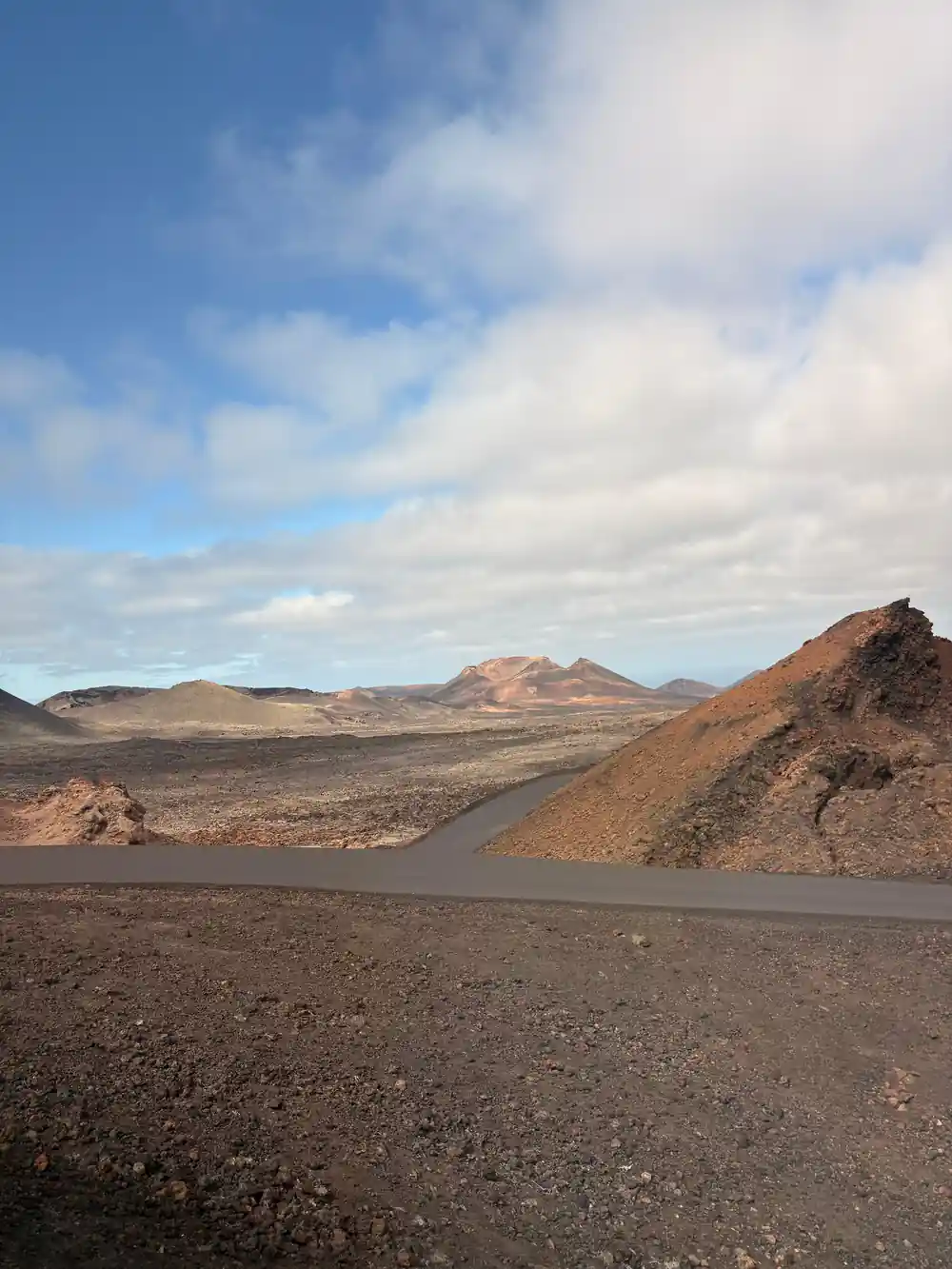
Timanfaya has lava tubes of its own: MITECO describes the park's sea of lava as an irregular surface full of caves, tubes and cavities.[9] Caving is on MITECO's list of activities forbidden inside the national park, together with outdoor sports.[10]
The tunnel that runs under the sea
UNESCO says the tube's last 1.6 kilometres are submerged, making it the longest submerged volcanic tube on the planet.[1] IGME calls that final stretch the Tubo de La Atlántida, and the most direct evidence of the global change in sea level during the last glaciation, between about 23,000 and 19,000 years ago.[5]
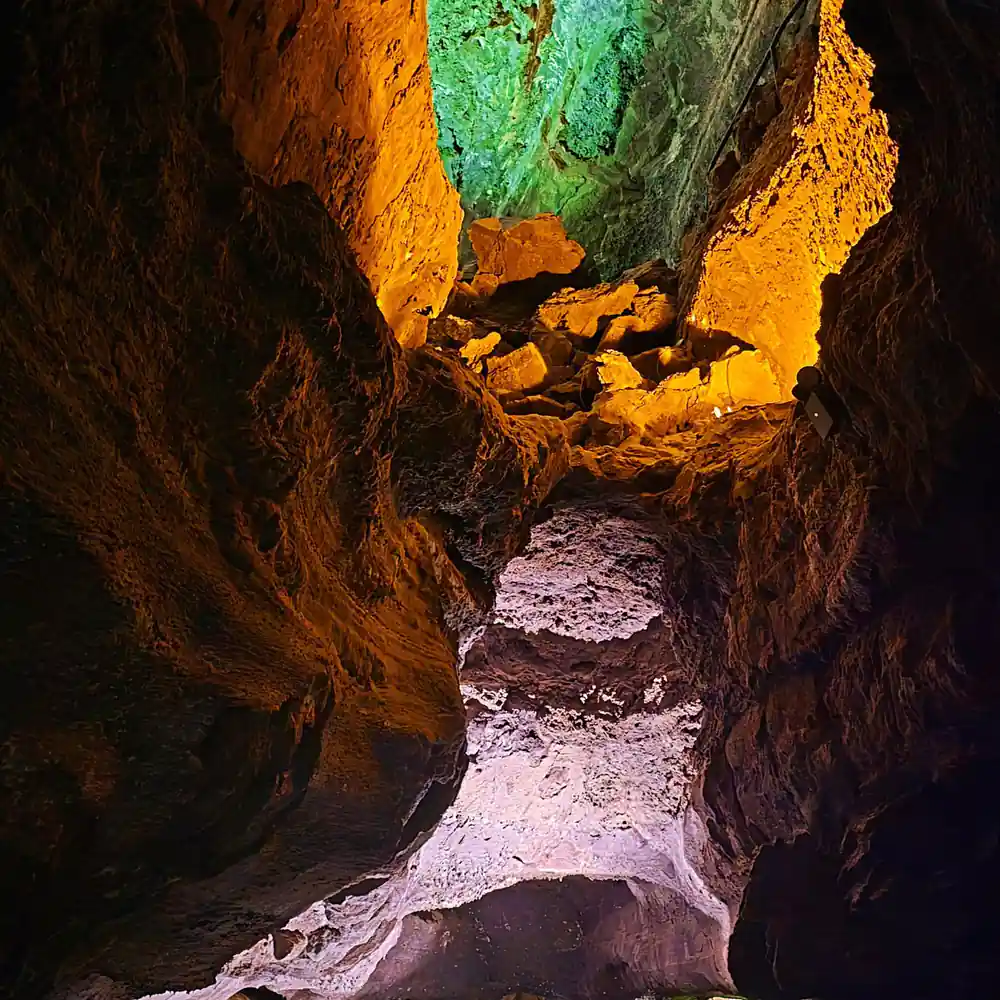
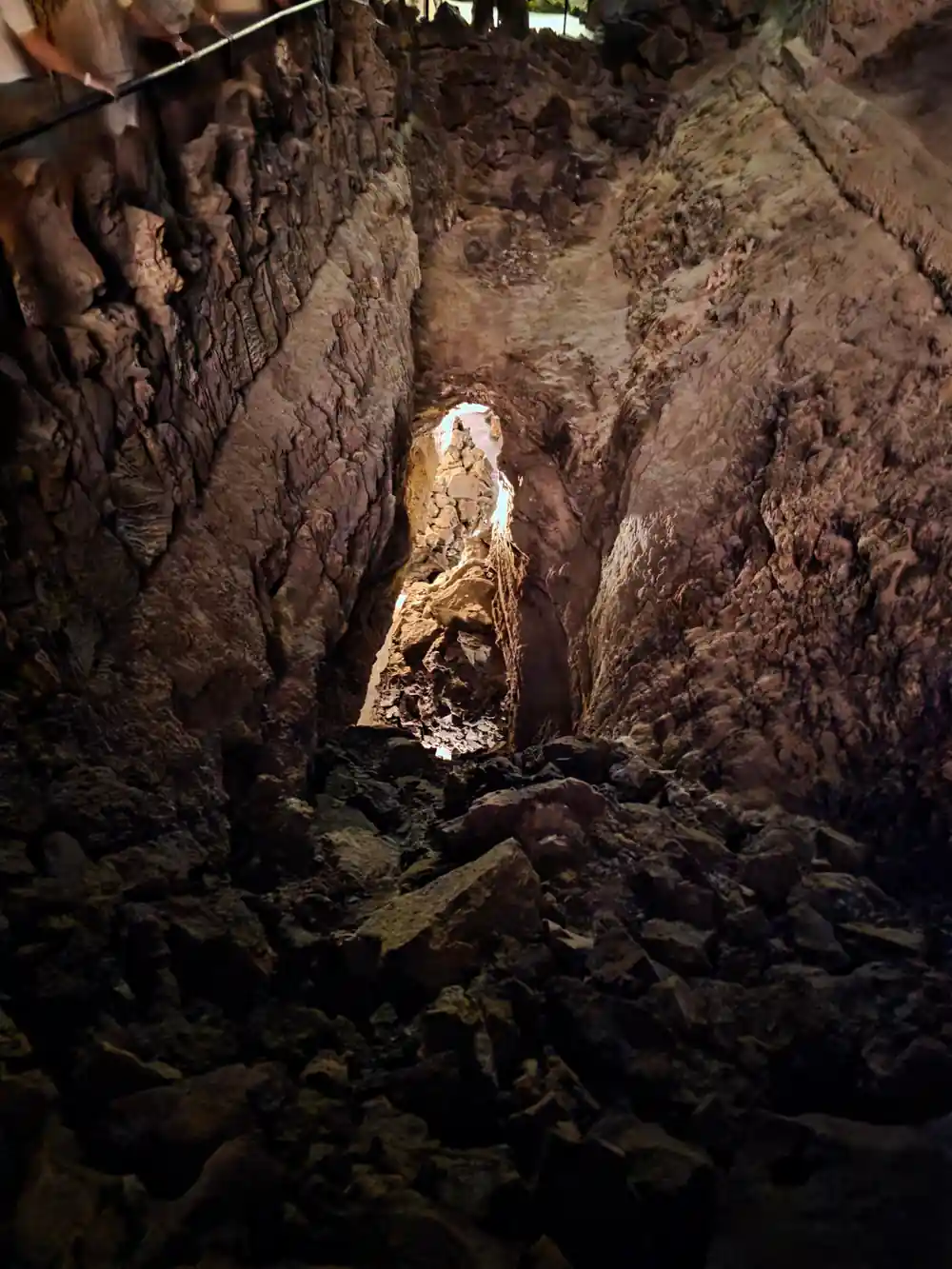
IGME ranks the Cueva de los Verdes, the Jameos del Agua and the Tubo de La Atlántida as the most valuable and representative geological elements of the whole tube, singling out the Cueva de los Verdes for the structures visible inside the tube and its mineralisations.[5] Inside, it describes a complex of passages and galleries stacked on top of each other, with vaults of up to 20 by 20 metres and small interior lagoons.[5]
UNESCO lists the La Corona Lava Tube as a prominent geosite of the Lanzarote UNESCO Global Geopark, a title the island received in 2015, where Timanfaya is the most significant of nearly seventy geosites.[1][11]
Turquoise water glows under the dark basalt of a lava tube
Cueva de los Verdes: a refuge and a guided walk
During the 16th and 17th centuries, local people used these galleries as a refuge from pirate raids from North Africa, CACT records.[2] Today the visit is a guided tour in Spanish and English through an atmosphere designed by the artist Jesús Soto, passing through the Auditorium.[2]
CACT gives opening hours of 09:30 to 16:45 every day, a visit of about 50 minutes and a ticket from €17.00, with children aged 0 to 6 free.[2] Booking a fixed date and time online is mandatory here, and there are no ticket sales at the box office.[6][7] When the entry time you want is not available, that slot's quota is already full, and if you arrive outside your scheduled time the ticket is no longer valid, with no changes or refunds.[7]
The route includes uneven paths, stairs, narrow spaces and low ceilings, and CACT states it is not accessible to people with reduced mobility and not recommended for people with claustrophobia.[2] CACT also notes that Cueva de los Verdes is the one centre in its network without a restaurant or café service.[7]
Jameos del Agua: a lake that follows the tides
At Jameos del Agua, the lake forms as seawater filters through fissures in the volcanic tube, and its level follows the tides and can reach the access walkway during spring tides.[3] The general ticket includes the descent through the Jameo Chico, the lake of the blind crabs, a visit to the Jameo Grande and access to the Auditorium.[3]
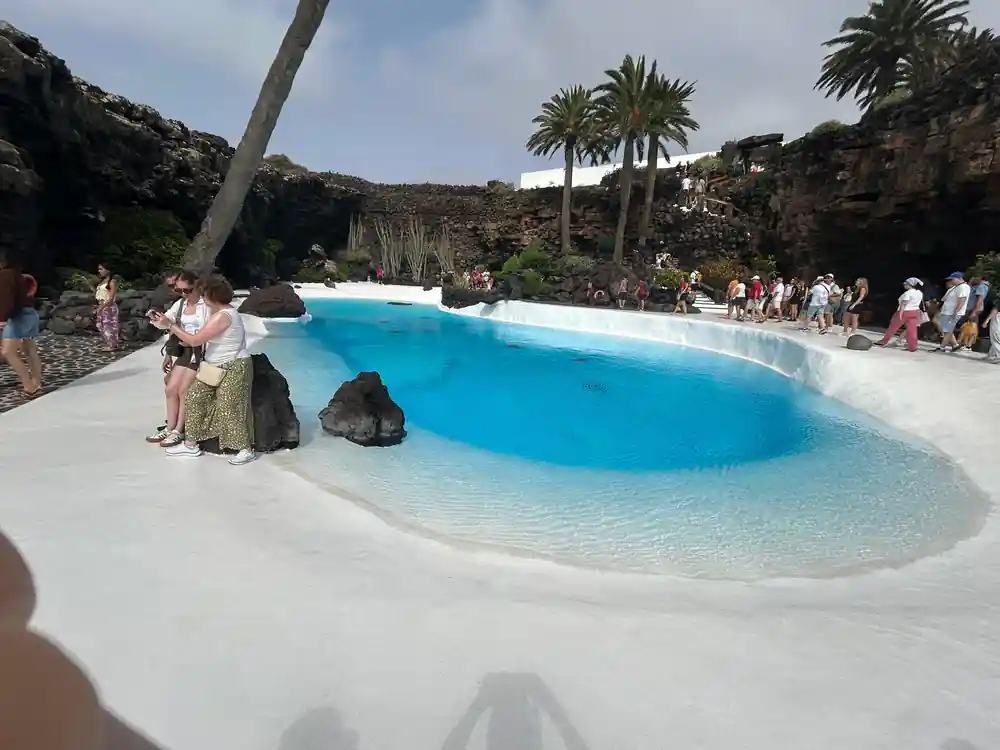
Beyond the lake, the darkness of the cave opens onto an outdoor garden with palm trees, fig trees and cacti, and a white pool with a leaning palm tree.[3] CACT lists opening hours of 10:00 to 18:00 every day of the year, last admission at 17:15, and tickets from €17.00, with children aged 0 to 6 free.[3]
For a smaller group, the Insólita Experience at Jameos del Agua starts at 09:45 on Tuesdays, Thursdays and Saturdays, lasts 2 hours and costs from €41.20.[3] The Jameos restaurant combines local produce with contemporary dishes such as tortilla conejera, or wreckfish with mojo sauces.[3]
1.6 km
The submerged end of the 7.6 km La Corona lava tube, which UNESCO calls the longest submerged volcanic tube on the planet.[1]
The blind crabs of the lake
The small white dots on the bottom of the lake are specimens of Munidopsis polymorpha, an endemic species adapted to darkness. To protect its habitat, CACT asks visitors not to throw coins or other objects into the water.[3]
CACT calls them the iconic blind albino crabs known as jameitos, and on Noches de Jameos evenings a concert overlooking their underground lake provides the finale.[12] Noches de Jameos combines gastronomy and music every Friday, with the restaurant serving from 6:30 pm to 8:30 pm and the concert from 10:30 pm to 11:15 pm.[12]
The menus cost from €98 per person for the standard menu, from €88 for the vegan menu and from €49 for a children's menu for ages 7 to 12.[12] On those nights Jameos del Agua stays open until midnight, and the self-guided visit of about one hour can be taken before or after dinner.[12] As a general rule CACT's cafés and restaurants do not open during evening cultural events, and Noches de Jameos, with dinner and a show, is its exception.[7]
Manrique, Soto and the Casa de los Volcanes
In 1968, the first Centre of Art, Culture and Tourism created by César Manrique opened at Jameos del Agua.[3] CACT credits the site also to the work of Jesús Soto and numerous craftspeople, technicians and workers from Lanzarote.[3]
IGME says the tourist facilities at Jameos del Agua and Cueva de los Verdes, designed by César Manrique and Jesús Soto, make them unique worldwide.[5] Jameos del Agua also houses the Casa de los Volcanes, a geological museum with an exhibition on general volcanology and the geology of Lanzarote; CACT says the visit takes around 60 minutes and includes a room dedicated to César Manrique.[3][5]
Both caves are also research sites. MITECO lists modules of the Laboratorio Geodinámico de Lanzarote at Cueva de los Verdes and at Jameos del Agua, with a third inside Timanfaya National Park, built into the Casa de los Camelleros.[13]
Seeing both caves on a tour
The tour booked from this site lists Timanfaya National Park, Cueva de los Verdes and Jameos del Agua as its stops, over a duration of 9 hours, with a live guide in English, French, German or Spanish and skip-the-line entry.[4] It is listed from US$102, with 61 pickup location options, reserve now and pay later, and free cancellation up to 24 hours in advance for a full refund.[4]
Other listings cover the caves alone. A 5-hour Cueva de los Verdes and Jameos del Agua tour, with a guide in English, German or Spanish, is listed from US$73.[14] A 1-hour guided tour of Cueva de los Verdes before opening hours is listed from US$44.[15]
Longer northern days also pair the caves: a 9-hour tour listed from US$96 names Cueva de los Verdes, Jameos del Agua and Mirador del Río as stops.[16] For cruise guests, a 3-hour Jameos del Agua and north island tour is listed from US$46.[17]
How long the Corona lava tube runs
Lengths in kilometres: UNESCO gives the whole tube and its submerged end; CACT gives more than seven kilometres of conduit, about one walked.[1][2]
Price a cave tour for your group
Each amount is that listing's own "from" price in US dollars, and the calculator applies the same listed figure to every traveller.[4][14][15]
Hours and times at the two caves
Along the Corona lava tube
Know how the tube formed
The La Corona volcano's eruption formed the tube about 25,000 years ago.[5]
Walk Cueva de los Verdes
A guided visit of about 50 minutes passes through the Auditorium.[2]
Descend the Jameo Chico
The Jameos del Agua ticket includes the descent and the lake of the blind crabs.[3]
Look for the white dots
The white dots on the lake bed are Munidopsis polymorpha, an endemic species adapted to darkness.[3]
Come out into the Jameo Grande
The cave opens onto an outdoor garden of palm trees, fig trees and cacti, with a white pool.[3]
Walk the Corona lava tube on the Timanfaya day tour
from US$103Reserve now & pay later